

Dr.-Ing. Prasanth Velvaluri
 I am an interdisciplinary researcher with expertise
in mechanical engineering, materials science, and neural implants. My current
work focuses on developing self-folding, origami-inspired brain implants. By
combining smart materials and MEMS fabrication, I design adaptive implants
tailored to patient-specific geometries, ensuring low-stress regions for
integrating electronic components.
I am an interdisciplinary researcher with expertise
in mechanical engineering, materials science, and neural implants. My current
work focuses on developing self-folding, origami-inspired brain implants. By
combining smart materials and MEMS fabrication, I design adaptive implants
tailored to patient-specific geometries, ensuring low-stress regions for
integrating electronic components.
My research centers on functional thin films and smart materials—particularly shape-memory alloys and magnetoelectric (ME) composites. These materials enable minimally invasive implantation and microscale wireless energy and data transfer. Through advanced MEMS integration and embedded electronics, I aim to build discrete battery-free, wireless, and intelligent implant systems.
My long-term goal is to bridge engineering and medicine through interdisciplinary solutions that merge materials science, microelectronics, and neurology. Ultimately, I aim to advance a new generation of smart brain implants that improve patient safety, precision, and therapeutic outcomes.

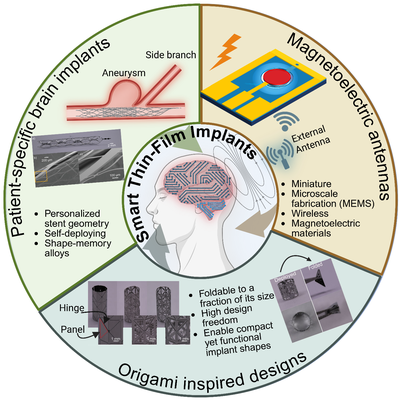

Smart Thin-Film Implants: Integrating Materials, Design, and Functionality
My research explores how patient-specific stent systems, magnetoelectric antennas, and origami-inspired designs can be integrated to enable adaptive, minimally invasive brain implants. By combining shape-memory materials, microscale fabrication, and foldable architectures, I aim to advance next-generation neurotechnologies for personalized treatment and wireless interfacing.
Figure adapted using images from ref (3-5 from the following publication list), Created using https://BioRender.com.

- 05/2025-now Postdoctoral researcher, Laboratory for Biomedical Microtechnology (IMTEK), Freiburg
- 05/2024-04/2025 Postdoctoral researcher, Feodor-Lynen Research Fellowship, Northeastern University, Boston, USA
- 01/2022-04/2024 Postdoctoral researcher, University of Kiel
- 10/2017-12/2021 PhD, Research Training Group 2154 - Materials for Brain, University of Kiel (grade: summa cum laude)
- 10/2015-09/2017 Master of Science, Material Science and Engineering, University of Kiel (awarded Best Master´s Thesis and Overall Grade)
- 06/2011-05/2015 Bachelor of Engineering, Mechanical Engineering, SCSVMV University, Kanchipuram, India (second in class)

-
DFG-project (04/2025 - 03/2028): Self-folding Origami Implants for Brain Aneurysms
-
Feodor-Lynen Fellowship (05/2024 - 04/2025): Magnetoelectric Antennas for Wireless Implantable System

Google scholar: https://scholar.google.com/citations?user=-ayFgn8AAAAJ&hl=en
Selected publications:
[1] Voß. S, Berg. P, Stahl. J, Behme. D, Janiga. G, Miranda. R. L, Quandt. E, Velvaluri. P, Flow diversion efficacy of novel helical thin-film implants for intracranial aneurysm treatment. 2510.05320, arXiv 10 2025, https://doi.org/10.48550/arXiv.2510.05320
[2] Jaykar. K, Velvaluri. P, Sun. Nian. X, James. R. D., Theoritical framework of passive ME antennas enabling in-vivo monitoring: A pathway to smart implants. 2509.23520, arXiv 09 2025, https://doi.org/10.48550/arXiv.2509.23520
[3] Luo. B*, Velvaluri. P* (shared first author), Liu. Y, Sun. N.-X, Magnetoelectric BAW and SAW Devices: A Review. Micromachines 2024, 15, 1471. https://doi.org/10.3390/mi15121471
[4] Velvaluri. P*, Pravdivtseva. M. S* (shared first author), Berg. P, Wodarg. F, Lima de Miranda. R, Hövener. J-B, Jansen. O, Quandt. E, (2021) Thin‐Film Patient‐Specific Flow Diverter Stents for the Treatment of Intracranial Aneurysms. Advanced Materials Technologies 8, pages 2100384..https://doi.org/10.1002/admt.202100384
[5] Velvaluri. P, Soor. A, Plucinsky. P, Lima de Miranda. R, James. R. D, Quandt. E, Origami-inspired thin-film shape memory alloy devices. Sci Rep 11, 10988 (2021). https://doi.org/10.1038/s41598-021-90217-3
ORCID ID: 0000-0002-0325-2153
LinkedIn: www.linkedin.com/in/prasanth-velvaluri
